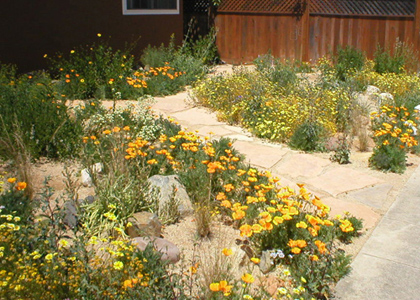
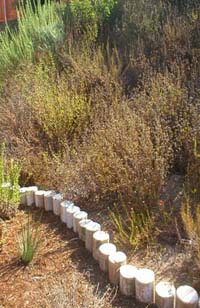
 There are distinct differences between local natives and the way plants from other climates behave. Native plants "spring" to life in early winter during the winter rains, with flowering periods starting at that time and running throughout spring. As things heat up in the summer, some of the local natives, those that are not evergreen, go dormant, similar to what happens to deciduous trees in winter in other parts of the world. It is true that for some, the ability to appreciate this property of some natives may be an acquired taste but there are definitely a growing number of people for whom the whole process of dormancy is beautiful. For example, the leaves of the Black Sage (Saliva melifera) begin to brown in May/June after the plant has finished flowering. Some of the leaves fall off right away, others remain for different lengths of time. This leads to beautiful contrasts between the ones that are still dark green on the top sides, the bottom sides of others that are light green, and those leaves that are turning different shades of brown. There are distinct differences between local natives and the way plants from other climates behave. Native plants "spring" to life in early winter during the winter rains, with flowering periods starting at that time and running throughout spring. As things heat up in the summer, some of the local natives, those that are not evergreen, go dormant, similar to what happens to deciduous trees in winter in other parts of the world. It is true that for some, the ability to appreciate this property of some natives may be an acquired taste but there are definitely a growing number of people for whom the whole process of dormancy is beautiful. For example, the leaves of the Black Sage (Saliva melifera) begin to brown in May/June after the plant has finished flowering. Some of the leaves fall off right away, others remain for different lengths of time. This leads to beautiful contrasts between the ones that are still dark green on the top sides, the bottom sides of others that are light green, and those leaves that are turning different shades of brown.
There are also ways in which fear of dormancy may be more than simply a matter of taste. On a conceptual level, it is interesting that so many people are unfamiliar with the idea of summer dormancy, even people who were born and grew up in California. To me, this fact suggests the extent to which imported horticultural standards have come to dominate or condition our expectations of what a garden should be, and even of what nature should be. This local blind spot is reflected by the fact that in temperate climates the concept of dormancy is accepted, and even appreciated during the winter. However, this tolerance for dormancy was not imported alongside the Eastern lawn-based traditions.
 Whatever the cause, we seem to have learned to expect gardens to behave as if we lived in New Hampshire, or Georgia, or as if San Diego were a Hawaiian island and not a desert climate. Whatever the causes, to fulfill these expectations and ideals we certainly water the heck out of our yards throughout the summer to attain them. Whatever the cause, we seem to have learned to expect gardens to behave as if we lived in New Hampshire, or Georgia, or as if San Diego were a Hawaiian island and not a desert climate. Whatever the causes, to fulfill these expectations and ideals we certainly water the heck out of our yards throughout the summer to attain them.
I suspect that accompanying the adoption of these foreign horticultural standards is the sentiment that seasons just get in the way. People want their gardens to reflect a constancy and uniformity that defies nature. Because of the mildness of our climate it has been possible to achieve this ideal, but we are slowly coming to realize the extent of the costs of this sentiment, and that it leads to waste on a very large scale.
Besides the waste of resources, a most unfortunate result of the horticultural ideal of our gardens looking the same all year round is a growing disconnect between people and the nature that surrounds them. It is not hard to see how this disconnect has lead to damaging consequences for the environment.
Despite the complexity of this issue, it is not hard to take dormancy into account in the planting plan. If natural dormancy during the dry summer months is considered undesirable, it can be minimized by planting evergreen natives in front of plants that go dormant, or by choosing not to use those which express dormancy at all.
|